TRANSMISSION // 2026.11.05.764619v1
Heat exposure may shift tree xylem’s vulnerability to drought
Source published
In experiments involving seven tree species, researchers report that heat exposure was associated with lower resistance to xylem embolism and faster dehydration. On average, the water potential at which xylem had lost 50% of its function shifted 0.73 MPa toward less negative values. Responses varied by species and were credibly different from zero only in the Australian species. The bioRxiv preprint offers preliminary evidence, not proof of effects on tree mortality in the wild.
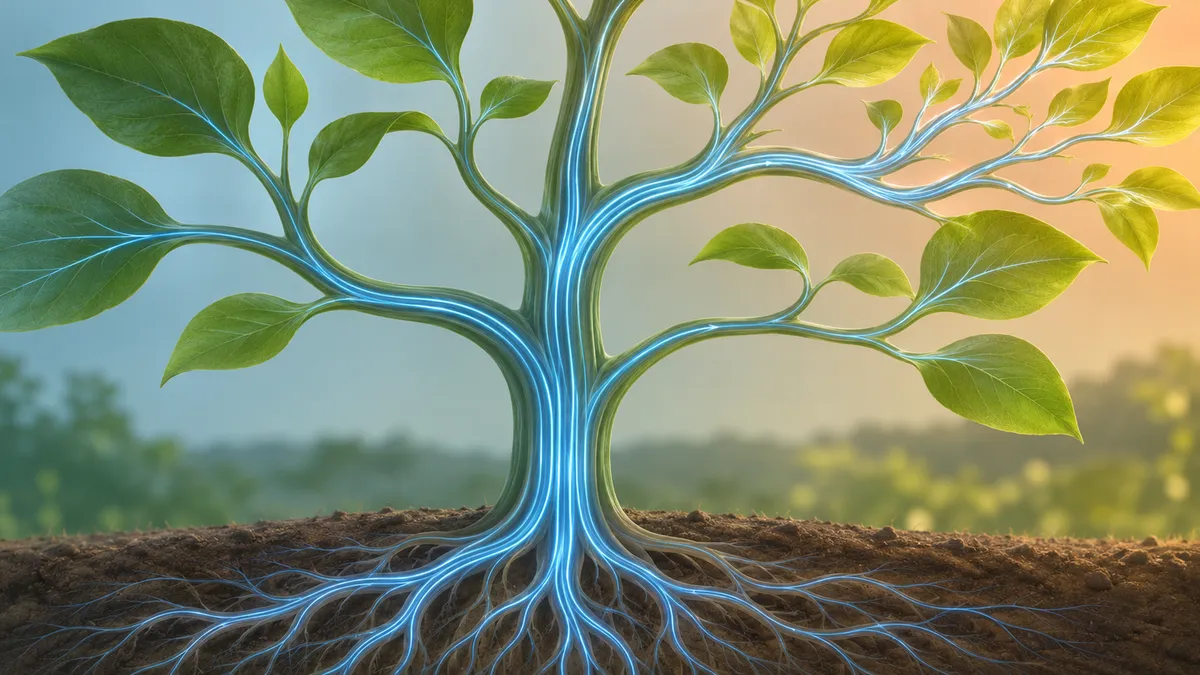
Can heat change how readily a tree’s water-transport system loses function during drought? A bioRxiv preprint explores that question with experiments on seven Australian and European tree species, alongside a theoretical framework about dissolved gas and bubbles in xylem sap. The abstract reports heat-associated changes, but species responses varied, and the supplied evidence does not include the full paper for independent assessment.
Heat and drought often occur together, but researchers commonly describe a plant’s resistance to drought-related loss of xylem function as if it were a stable characteristic. R. M. Link and colleagues ask whether heat exposure can change that vulnerability and whether it is associated with faster dehydration.
The authors first propose a theoretical framework about how dissolved gas affects the stability of bubbles in xylem sap. In that framework, sudden temperature increases, when gas is present, could accelerate embolism formation. This is a proposed explanation; the abstract does not establish that the mechanism operates in the same way in trees under field conditions.
The researchers assessed seven tree species from Australia and Europe. They exposed plants to temperatures 15 or 20 degrees Celsius above ambient, then assessed embolism resistance using the Optical Vulnerability Technique and measured drying times corrected for vapour-pressure deficit (VPD), a factor relevant to atmospheric drying demand. The abstract does not give sample sizes, exposure duration, or enough detail to evaluate the full experimental design.
The authors report evidence of reduced embolism resistance and accelerated dehydration in heat-exposed plants. Their average result for the water-potential threshold needs careful wording: the water potential at which xylem function had fallen by 50% was, on average, 0.73 MPa less negative after heat exposure. This describes a shift in the threshold, not the threshold’s absolute value. The abstract also reports that the VPD-corrected drying-time measure was “7.8 kPa h earlier.” It does not explain this unit further, so the figure cannot be translated into hours based on the supplied information.
Responses differed substantially among species. The authors say the changes were credibly different from zero only in the Australian species. The reported average therefore should not be read as a uniform response across all seven species, much less across trees generally.
The findings are consistent with the authors’ proposed framework, but consistency does not demonstrate that the framework explains the experimental results. Nor does this experiment, as described in the abstract, show that heat-induced changes in xylem vulnerability cause tree death. The authors say further work is needed to assess whether such changes contribute to mortality during heatwaves.
The result raises a question for plant research: might drought vulnerability depend partly on recent heat exposure, rather than being a fixed value? If confirmed, that possibility could matter when researchers measure or compare plant responses to drought. But this study does not establish how large any effect is across natural conditions or predict what will happen to forests during future heatwaves.
This article is based on the preprint abstract alone. The full methods, figures, and statistical analyses were not available in the supplied evidence, so the experimental details and interpretation cannot be checked here. The source is a bioRxiv preprint; the supplied material does not establish peer-review status. The findings should therefore be treated as preliminary.
- xylem
- tree drought
- heat exposure
- embolism
- plant water stress
- preprint