TRANSMISSION // 2026.11.05.764528v1
Maltose boosts hybrid fir embryo yield—but healthy seedlings remain a hurdle
Source published
A preprint reports far more mature embryos from one hybrid fir culture grown with maltose rather than sucrose, alongside earlier accumulation of raffinose. The sugar patterns offer clues to maturation, but do not establish its mechanism or guarantee normal seedling development.
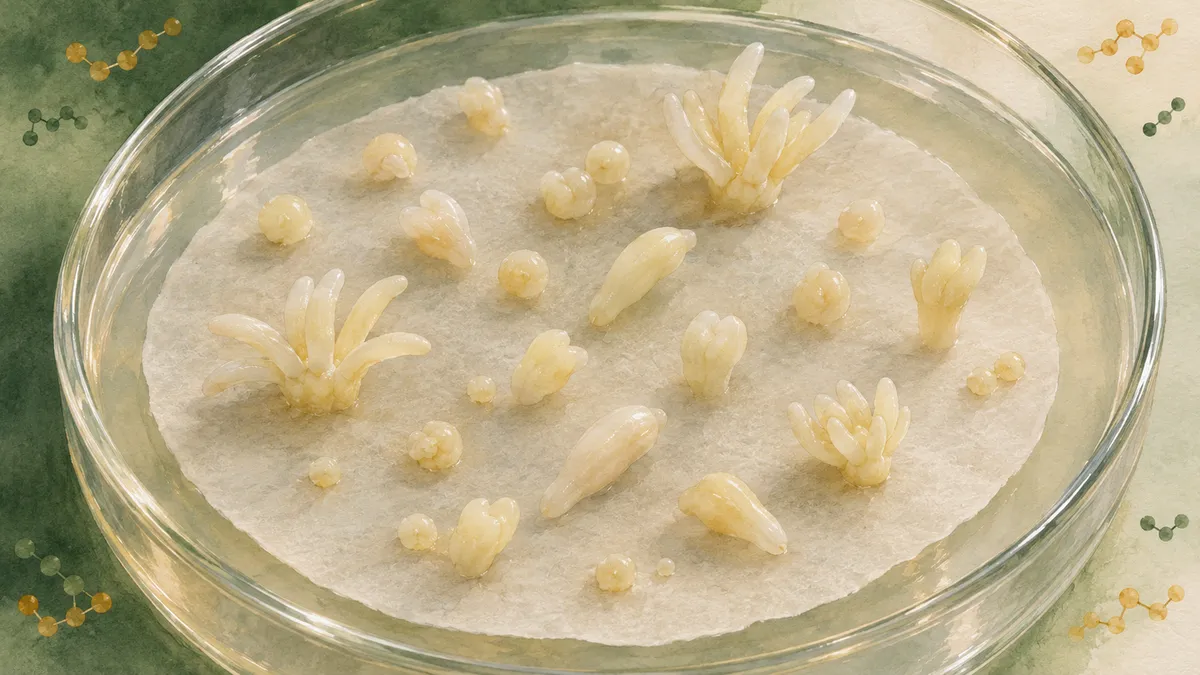
Changing the sugar in a laboratory culture can dramatically alter how many fir embryos develop. Yet producing embryos and producing healthy young trees are different achievements—and this study exposes that gap.
What helps a laboratory-grown fir embryo mature—and does that mean it can become a healthy tree? A study by Ondřej Skala, Helena Lipavská, Terézia Salaj and Hana Konrádová finds a strong advantage for maltose over sucrose during embryo production, but also reports abnormalities during subsequent germination. Posted on bioRxiv on November 6, 2026, the work is a preprint and has not been certified by peer review.
The researchers studied somatic embryogenesis: growing embryos from cultured plant tissue rather than through fertilization. The technique offers a way to multiply selected fir genotypes. Its difficult stages include not only making embryos, but getting them to germinate and develop into plantlets. An embryo that looks mature may not be physiologically ready for those later steps.
Two sugars, sharply different yields
The experiment used AN72, a single culture line of hybrid fir, Abies alba × Abies numidica. During maturation, the team compared media containing 3.16% maltose monohydrate or 3% sucrose by weight per volume. Both are sugars supplied as carbon and energy sources.
Other maturation ingredients were shared, including abscisic acid, a plant hormone, and polyethylene glycol, an additive used to alter water availability. After eight weeks, the cultures spent another week on finishing media without those two ingredients, retaining their respective sugar sources.
Maltose-grown tissue developed slowly but steadily and produced numerous embryos. Sucrose-grown tissue initially expanded rapidly, then slowed, often turning brown. The reported yield averaged 133 mature embryos per dish with maltose, compared with 3 with sucrose. Standard deviations were 74 and 2, respectively, across 24–27 dishes per treatment, showing substantial variation around those averages.
Maltose-grown embryos were described as shorter and robust. During maturation, sucrose-grown embryos often had impaired development at the root-forming end or germinated prematurely. These observations support a maturation advantage for maltose under the tested conditions—not a universal result for every fir species or culture line.
A biochemical clue appears early
The team also measured soluble carbohydrates inside the cultured material using high-performance liquid chromatography, a technique that separates compounds for measurement.
At week four, sucrose-grown tissue was dominated by hexoses, simple six-carbon sugars such as glucose and fructose. Maltose-grown tissue contained mainly two-unit sugars, particularly maltose. It also contained raffinose, whereas raffinose-family sugars were undetectable in the sucrose treatment at that stage.
Raffinose belongs to the raffinose family oligosaccharides, or RFOs: sugars built by adding galactose units to sucrose. The paper discusses their roles in seed development, energy storage and protection during drying. Their presence can therefore provide a clue about developmental state, but is not proof of readiness to germinate normally.
Importantly, the week-four measurements came from the whole embryo-producing tissue mass, not isolated embryos. By week eight, isolated maltose-grown embryos contained 22.2 micrograms of total RFOs per milligram of dry weight, compared with 7.2 in sucrose-grown embryos. Sucrose nevertheless predominated inside embryos from both treatments by that stage.
The authors propose that maltose supplies carbon more slowly and steadily, encouraging maturation rather than continued tissue multiplication. They suggest that excess fructose may contribute to poor development in sucrose-grown cultures. However, their measurements did not directly establish the proposed breakdown rates, transport limitations or toxicity mechanisms. Nor did they show that early raffinose accumulation itself caused the higher embryo yield: it could accompany other developmental changes.
Maturation is not the finish line
After maturation, embryos underwent two weeks of slow drying at high humidity. The proportion of RFOs among measured soluble carbohydrates increased in both treatments and remained higher in maltose-derived embryos. That proportional advantage should not be confused with greater total soluble carbohydrate content: after drying, the sucrose-derived embryos had more total soluble carbohydrates.
Both groups then germinated on medium containing sucrose. After three weeks, RFOs were no longer detected in either group, consistent with their possible use during germination, although disappearance alone does not establish their precise function.
Crucially, the results explicitly report abnormal development in germinating embryos previously matured on maltose, particularly poorly developed roots. That later observation is distinct from the root-end defects and premature germination reported during sucrose-supported maturation. A large embryo harvest therefore did not demonstrate reliable production of normal seedlings.
The study is limited to one hybrid line, and the scarcity of sucrose-grown embryos reduced sample availability for some later measurements. It does not establish successful field propagation, long-term survival or improved forest performance. Its clearest contribution is a strong culture-specific maturation response, accompanied by sugar patterns that suggest mechanisms worth testing—not a completed route from laboratory tissue to healthy trees.
- hybrid fir
- Abies
- somatic embryogenesis
- maltose
- sucrose
- raffinose
- embryo maturation
- germination