TRANSMISSION // 2026.11.05.764495v1
DNA barcodes and flavonoids help distinguish two forms of Tibetan “Tale”
A study of nine Rhododendron species found that one DNA region separated plants used as Talegabao from those used as Talenabao, while another was too similar across most samples to do so. Chemical tests detected all ten measured flavonoids in both groups, but their average combined amounts were higher in Talegabao. The results may support identification and quality research; they do not establish medical effectiveness or safe dosing.
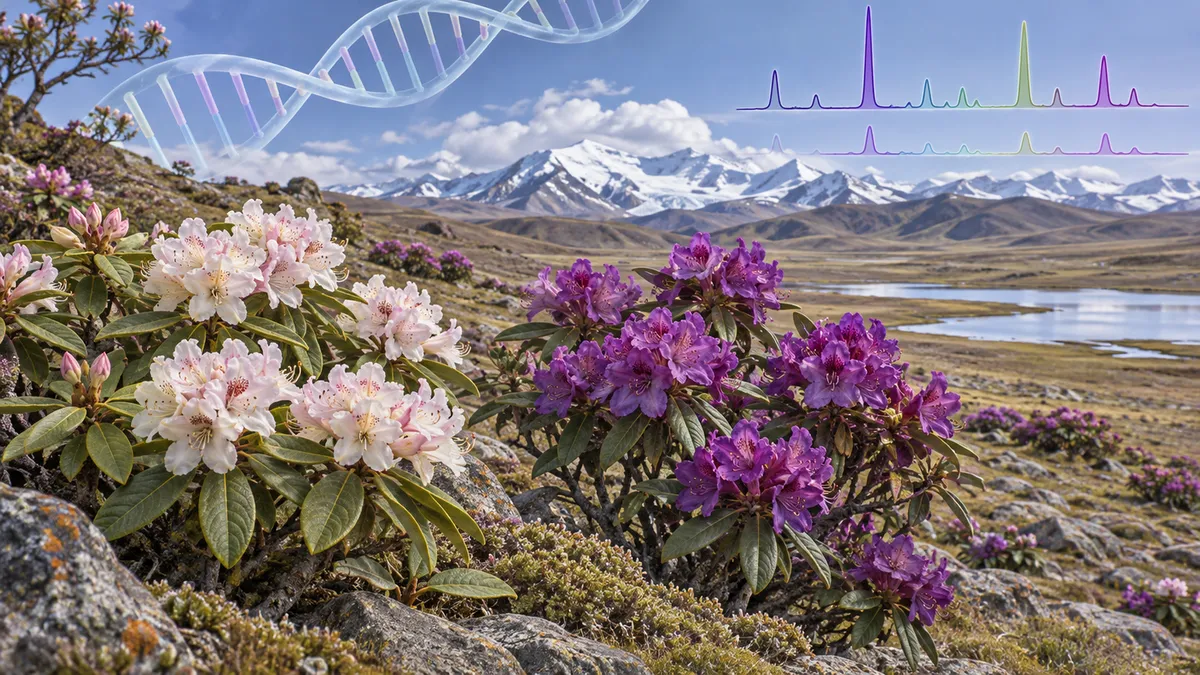
“Tale” is a traditional Tibetan medicine made from several Rhododendron species. Researchers compared two customary categories—Talegabao and Talenabao—using DNA sequences and measurements of plant chemicals. Their results offer possible tools for telling the categories apart, but leave important questions about medicinal use unanswered.
Traditional medicines made from plants can involve several related species, sometimes grouped under one name. That creates a practical challenge: how can researchers identify which plants are being used, and do the different botanical sources have measurably different chemical profiles? A new bioRxiv preprint investigates those questions for “Tale,” a traditional Tibetan medicine made from Rhododendron plants on the Qinghai–Xizang Plateau.
In traditional practice, Tale is divided into Talegabao and Talenabao, which are associated with different Rhododendron species. The paper describes Talegabao as the preferred type and Talenabao as an alternative. The authors set out to test whether DNA sequences could help distinguish the two groups and whether their measured flavonoid content differed.
The team collected 46 plant specimens representing nine Rhododendron species, along with nine crude-drug samples purchased in markets. They sequenced two short DNA regions: ITS2, from nuclear DNA, and psbA–trnH, from chloroplast DNA. These regions act like molecular labels: if their sequences differ reliably among groups, they can help identify a plant sample. The researchers also used high-performance liquid chromatography, or HPLC, to measure ten selected flavonoid compounds in plant and drug samples. In simple terms, HPLC separates chemicals in a sample so their amounts can be estimated.
The two DNA regions did not perform equally. The psbA–trnH region distinguished the sampled species used as Talegabao from those used as Talenabao. ITS2 was more conserved—its sequence varied less across the samples—and was much less useful for that distinction. But neither region identified every one of the nine species separately. The barcode result is therefore best understood as a way to distinguish the two broad medicine categories in this sample set, not as a complete identification system for all Tale plants.
All ten measured flavonoids were detected in the samples. Their amounts varied, both between the two categories and among species within each category. On average, the combined amount of the ten compounds was more than twice as high in Talegabao samples as in Talenabao samples. The authors report that nine of the ten compounds had higher average amounts in Talegabao; dihydromyricetin was the exception. Some individual compounds also differed among species, which the authors suggest could be useful when developing chemical markers for quality assessment.
These measurements describe chemical composition—not treatment outcomes. The study did not test whether either category treats illness, whether flavonoid amounts explain any reported traditional effects, or what dose would be appropriate. The paper itself says dosing for Talenabao needs further discussion in clinical practice. It also notes that Rhododendron species can contain toxic constituents, an issue that should be considered in future standardization work. Higher amounts of selected compounds should not be read as proof that one preparation is safer or more effective.
The findings are also bounded by the sampling and methods. The work covered nine species and samples from a specific region and market sources; it cannot establish how representative those samples are of all plants or products called Tale. The tested DNA markers did not resolve every species, and the ten measured flavonoids are only one part of a plant’s chemistry. The authors point to further work on additional species, chemical indicators, pharmacological effects, essential oils and toxic compounds.
This report is a bioRxiv preprint, posted in November 2026, and the version supplied here states that it has not been certified by peer review. Its results are preliminary and should be weighed accordingly. For now, the study offers a promising identification lead and evidence of chemical differences between two traditional categories—not a clinical recommendation.
- Rhododendron
- Tibetan medicine
- Tale
- DNA barcoding
- flavonoids
- plant identification