TRANSMISSION // 2026.11.05.764492v1
Hibiscus study shortlists three cultivars for food research—not a safety endorsement
Source published
A non-peer-reviewed preprint ranks 11 Hibiscus mutabilis cultivars using measurements and expert-selected priorities. Three lead the scoring system, but the results do not establish food safety, nutritional benefits or consumer acceptance, and conflicting descriptions need clarification.
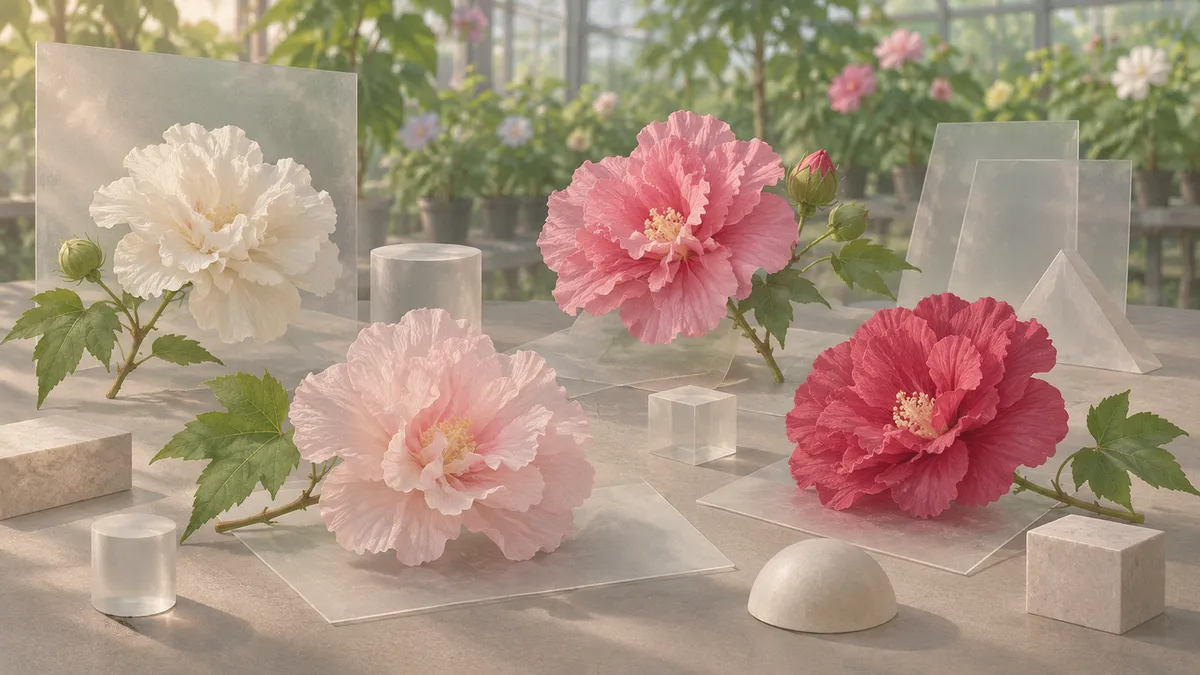
Which ornamental hibiscus flowers deserve closer investigation as food ingredients? Researchers at Chengdu Botanical Garden offer a preliminary shortlist, combining laboratory measurements with expert judgments about safety-related characteristics, composition, texture and supply. Their rankings identify candidates for further research, not flowers proven suitable to eat.
Three cultivars of Hibiscus mutabilis—'Bairi Huacai', 'Chongbanbai' and 'Jinqiusong'—came out ahead in a study comparing their potential for food development. The work, posted on bioRxiv on November 6, 2026, is a preprint that has not been certified by peer review. Its central result is a weighted ranking, not evidence that these ornamental flowers are safe, nutritious or appealing as finished foods.
Hibiscus mutabilis is a deciduous shrub or small tree widely cultivated ornamentally in China. A cultivar is a cultivated plant variety. The researchers examined 11 cultivars from Chengdu Botanical Garden, sampling fully opened, visibly undamaged flowers in mid-October 2025. For each cultivar, they collected flowers from three plants, pooling 13 flowers from each plant into a separate biological replicate: three independently collected samples per cultivar.
The team first used the Delphi method, a structured process of repeated expert consultation, to choose evaluation criteria. The first round produced 28 valid questionnaires from 32 distributed. After two rounds, the framework contained 12 indicators covering safety-related risks, nutritional and other plant compounds, sensory characteristics, and raw-material supply. Indicators included heavy metals, microbial contamination, amino acids, texture, flower yield and storability. Allergenicity was considered initially but removed from the final framework.
Next came the analytic hierarchy process, or AHP: a method that turns pairwise comparisons of importance into numerical weights. Safety received 41.68% of the total weight, composition 26.95%, supply characteristics 19.28% and sensory quality 12.09%. Measurements and sensory results were converted into scores from one to five and combined using those weights. These percentages express expert priorities, not probabilities of safety or measures of health benefit.
'Bairi Huacai' scored 3.6043, 'Chongbanbai' 3.5533 and 'Jinqiusong' 3.5055. All passed the study's Grade I threshold of 3.5. Six cultivars fell into Grade II: 'Jinqiuhong', 'Zuifurong', 'Danbanhong', 'Jinxiuzi', 'Jinbiyu' and 'Caixia'. 'Mudanfen' and 'Jinrui' received Grade III scores, at 2.7113 and 2.5785. These are categories defined by the researchers, not regulatory food grades. 'Jinqiuhong', at 3.4930, sat just below the Grade I boundary.
The individual results show why the overall ranking needs context. 'Bairi Huacai' had the highest reported fresh and dried flower yields, but also the highest total tannin content. Tannins were used as a chemical indicator of lingering astringency—the drying, puckering mouth sensation. 'Jinxiuzi', despite ranking seventh overall, led in total flavonoids and amino acids. Flavonoids are a class of plant compounds; measuring their concentration does not demonstrate a benefit from eating the flowers.
Safety-related measurements also varied within the leading group. The authors report relatively high levels of certain microbial indicators in 'Bairi Huacai' and 'Chongbanbai', as well as in 'Mudanfen'. Staphylococcus aureus was not detected in any cultivar, but that finding does not establish the absence of other hazards. Free gossypol, the compound measured to assess gossypol-related toxicity risk, was detected in four cultivars, with 'Mudanfen' highest. Results below a detection limit mean the assay did not detect the compound, not that none was present.
Importantly, the published scoring formula adds safety-related scores to composition, sensory and supply scores. It does not specify a mandatory safety exclusion before ranking. Consequently, stronger yield or composition scores can offset weaker safety-related scores mathematically. A high composite score cannot substitute for compliance with applicable food-safety requirements. Removing allergenicity from the framework also leaves that question unanswered.
The study likewise does not establish nutritional benefit or consumer acceptance. Concentrations of amino acids, minerals and flavonoids describe composition; they do not show how much a person would consume, absorb or benefit from in a prepared product. Although the paper refers to sensory evaluation, it does not provide a detailed tasting-panel protocol or report consumer validation of finished foods. Chemical estimates of astringency are not equivalent to demonstrated consumer preference.
Several limitations restrict interpretation. Sampling covered one garden and one collection period, with three biological replicates per cultivar, so the results do not establish performance across locations or seasons. The methods do not adequately describe the analytical assays, detection limits, storage conditions or basis for the scoring thresholds. The paper also reports no analysis testing whether rankings remain stable when expert weights change—particularly relevant near grade boundaries.
There are unresolved contradictions. The results identify 'Chongbanbai' as highest in storability, while the discussion calls its storability relatively weak. 'Jinbiyu' is described as accumulating relatively high levels of certain heavy metals, yet later appears among the best heavy-metal risk scores without a clear explanation of how those measurements were combined. These discrepancies need clarification. The defensible takeaway is a preliminary shortlist for further safety assessment, processing trials and sensory research—not a recommendation to eat ornamental hibiscus.
- Hibiscus mutabilis
- cultivar screening
- food development
- Delphi method
- analytic hierarchy process
- food safety
- sensory evaluation
- preprint