TRANSMISSION // 2026.11.03.764026v1
Hop varieties respond differently to reduced watering, greenhouse study finds
A 12-week greenhouse experiment found cultivar-specific responses to reduced irrigation in hops, alongside differences in root-associated microbes. The unreviewed preprint identifies Comet and Chinook as breeding candidates, but does not establish microbial protection or preserved commercial yields.
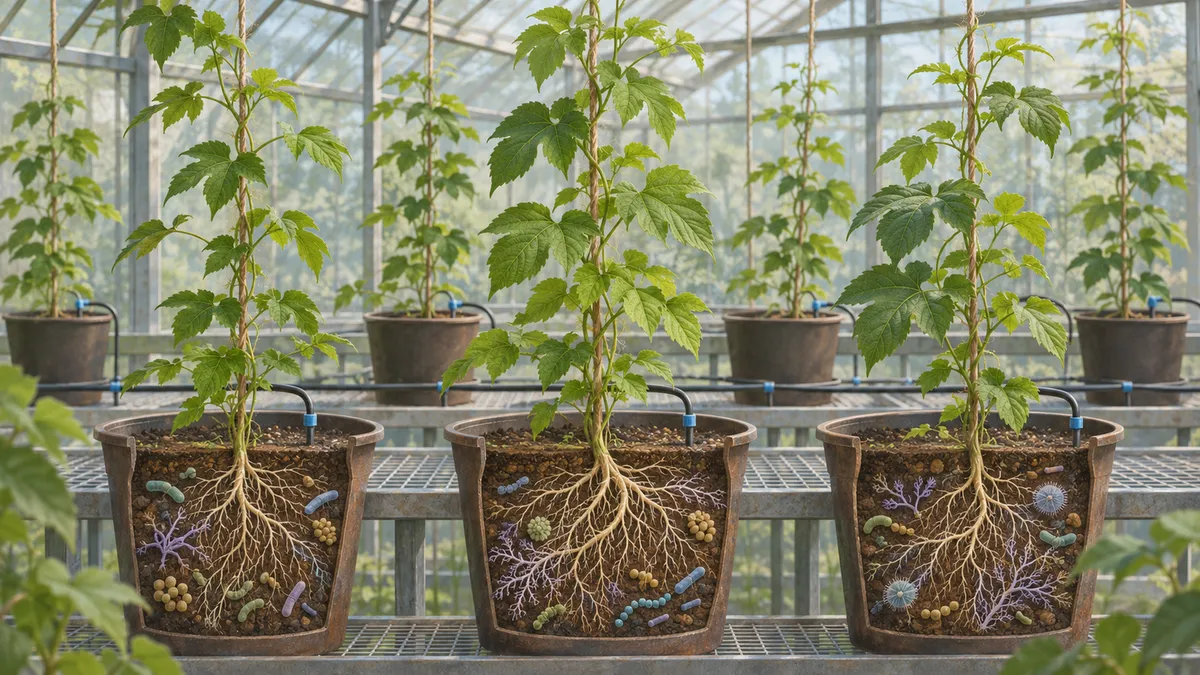
Which hops can cope with less water—and could their root-associated microbes help explain why? A greenhouse study of five cultivated varieties offers preliminary clues, while leaving the mechanisms behind those differences unresolved.
Reducing irrigation did not produce the same response in every hop variety in a greenhouse experiment reported in an unreviewed bioRxiv preprint. Researchers compared plant growth, leaf traits, soil nutrients and root-associated microorganisms across five cultivars. Their findings suggest that breeding for reduced-water conditions may benefit from examining both the plants and their belowground communities, but they do not demonstrate that particular microbes cause drought tolerance.
Five varieties, three watering regimes
The team studied Cascade, Centennial, Chinook, Comet and CTZ, short for Columbus/Tomahawk/Zeus. The experimental design assigned 450 plants to three watering regimes, with 30 plants per cultivar in each regime, during a 12-week greenhouse trial in San Diego from July through September 2025.
The reported weekly irrigation targets were approximately 850 millilitres per pot for the control, 600 millilitres for moderate restriction and 425 millilitres for severe restriction. Water was delivered through drip irrigation twice weekly.
Researchers measured plant height each week and collected aboveground biomass at the end. They also photographed sampled leaves to estimate area and circularity, a measure based on leaf area and perimeter. Soil collected near roots in weeks two and twelve provided material for DNA sequencing of bacterial, archaeal and fungal markers. Separate chemical analyses measured extractable nutrients and dissolved organic carbon.
Biomass and growth tell different stories
The clearest message was variation among cultivars, rather than a uniform decline across every measurement.
Chinook had its highest average aboveground biomass under moderate watering restriction: about 17.4 grams, compared with 12.5 grams in the control and 14.9 grams under severe restriction. Its biomass differed significantly among all three treatments. CTZ also showed significant treatment differences, with lower biomass under severe restriction than under either control or moderate watering.
Comet averaged approximately 17.4, 16.6 and 15.3 grams across control, moderate and severe treatments, respectively. Its overall biomass comparison did not meet the study’s statistical significance threshold. Neither did those for Cascade or Centennial. That distinction matters: a nonsignificant result does not establish that reduced watering had no effect, or that Comet alone maintained biomass.
Across cultivars, the growth analysis detected effects of watering regime, cultivar and week. Control and moderate treatments did not differ significantly in the reported overall comparison, whereas severe restriction differed from both. Leaf area also varied with treatment and cultivar. Leaf circularity differed among cultivars, but the overall watering effect on circularity was not significant.
Microbial associations, not proven protection
The sequencing results pointed to differences involving particular microbial groups, especially across cultivars and sampling times. Fungal and archaeal analyses did not detect significant watering-by-microbial-group interactions, while the bacterial analysis did.
Bacillaceae stood out in the treatment-specific bacterial results. Its relative abundance was highest under moderate restriction and lowest under severe restriction. The archaeal group Thaumarchaeota was more abundant around Chinook and Comet than around the other cultivars and declined between the two sampling times.
The authors discuss these organisms as possible contributors to plant resilience, drawing on earlier research about microbial growth promotion and nutrient cycling. Their own experiment, however, measured associations rather than testing microbial inoculations or directly establishing those functions in hops.
Soil chemistry also varied. Extractable nitrate differed with both cultivar and watering regime, while dissolved organic carbon showed a cultivar-by-treatment interaction. These measurements describe the root-zone environment; they do not establish which organisms caused the nutrient patterns or whether those patterns improved plant performance.
Breeding clues with important limits
The authors identify Comet and Chinook as promising breeding candidates and connect their responses to pedigrees involving wild Utah hop breeding lines. They propose exploring wild American ancestry, particularly the variety neomexicanus. The experiment does not identify causal genetic variants or demonstrate that this ancestry produced the observed responses.
Interpretation also requires caution because parts of the discussion conflict with the reported results. For example, the discussion describes Comet as the only cultivar without significant biomass differences, although the results and tables also report nonsignificant differences for Cascade and Centennial.
The evidence comes from one greenhouse trial in pots, with microbial sequencing restricted to a small subset of plants. Reported biomass group sizes were smaller and uneven compared with the planned allocation. The study measured vegetative performance, not harvested cone yield or brewing chemistry. Its practical contribution is therefore a set of cultivar comparisons and mechanistic hypotheses—not a demonstrated irrigation prescription or a proven microbial treatment.
- hops
- Humulus lupulus
- reduced irrigation
- drought response
- rhizosphere
- soil microbiome
- plant breeding
- preprint