TRANSMISSION // 2026.11.03.764016v1
Cacao DNA offers clues to black pod resistance from a sparse disease screen
Source published
A non-peer-reviewed preprint reports that genetic relationships among cacao clones helped predict resistance to Phytophthora megakarya in detached-pod tests. Pathogen relatedness added no predictive benefit after broad pathogen groups were accounted for in this dataset. The findings could guide further screening, but require field and independent-population validation.
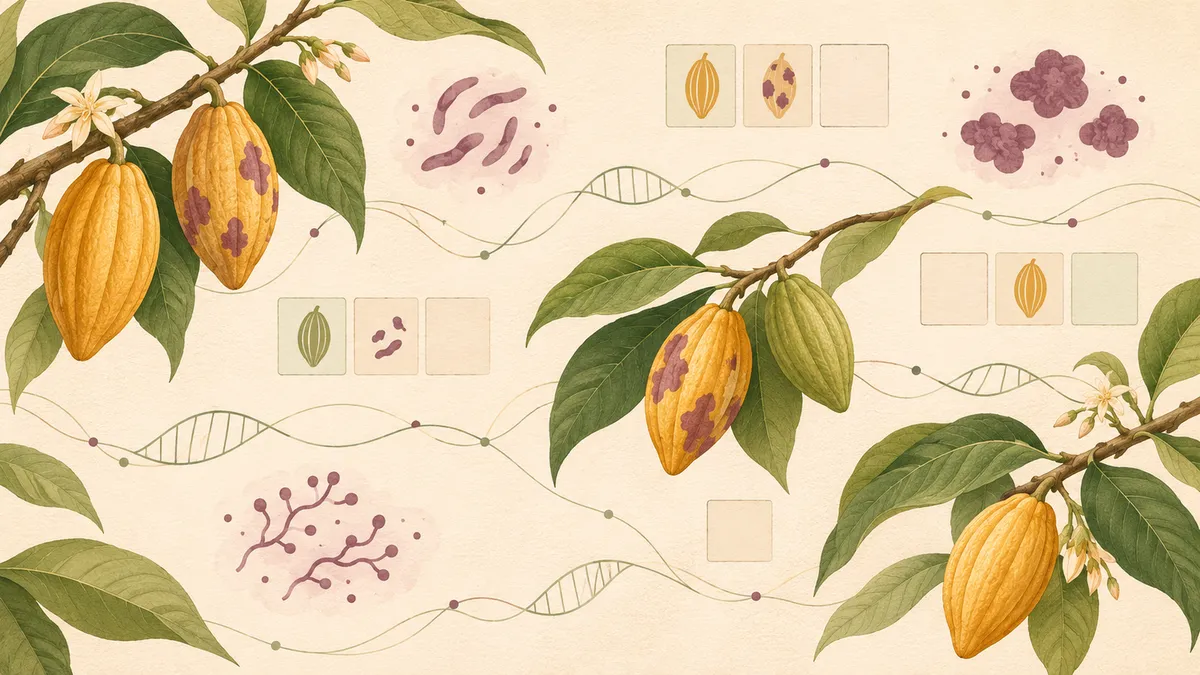
Testing every cacao variety against every pathogen isolate is difficult when pods are available unevenly and disease screening requires containment. A new preprint explores whether DNA-based relationships can connect those scattered tests and help identify promising material for further evaluation.
Black pod rot threatens cacao production in West and Central Africa, where the pathogen Phytophthora megakarya occurs. Breeding for resistance is challenging: cacao improvement is slow, and resistance involves reduced disease severity rather than demonstrated complete immunity. Researchers therefore need ways to decide which material deserves detailed testing.
Ina Schlathoelter and colleagues report a possible route in a bioRxiv preprint that has not been peer-reviewed. Their study combines cacao and pathogen genetic information with laboratory disease measurements. The authors describe it as the first genomic prediction of cacao resistance to P. megakarya—a claim about predicting performance, not the discovery of immune trees.
A large genetic collection, a smaller disease screen
After quality and relatedness filtering, the cacao genetic dataset retained 947 clones from CATIE’s International Cacao Collection in Costa Rica. The researchers also genetically characterized 67 pathogen isolates. These numbers describe the genetic resources, not the number of clones and isolates contributing to the genomic prediction tests: those used disease measurements from 350 genotyped clones challenged with 58 isolates across 30 bioassays.
For the detached-pod assays, harvested, unwounded cacao pods were shipped to the University of Florida and inoculated with pathogen spores. Researchers measured lesion diameters four days later. Smaller lesions indicated greater resistance under those assay conditions.
The screen was sparse and uneven because pod availability constrained which combinations could be tested. Only about 5% of possible clone–isolate combinations were examined, and most tested combinations were assessed once. Many isolates were never tested on the same clone, limiting direct comparisons. Statistical models were used to account for bioassay differences and broad pathogen groups while estimating clone and isolate effects.
What cacao relationships contributed
Genomic prediction uses genetic markers and measured performance in a training set to predict performance in genetically related material. It does not require identifying the DNA changes that cause resistance.
Here, including genetic relationships among cacao clones improved model fit. To evaluate predictions for clones without disease measurements, the team repeatedly withheld all observations for selected clones, fitted the model to the remaining records, and compared predictions with adjusted observed clone means.
The reported predictive ability was about 0.41. This is a Pearson correlation between predictions and observations, not 41% accuracy or the percentage of clones correctly classified. Because withheld clones generally still had relatives in the training set, the result describes prediction within the related CATIE collection. It does not establish performance in genetically distinct breeding populations.
Pathogen differences still mattered
The isolates formed three geographically structured subpopulations. Isolate effects and broad subpopulation differences contributed to lesion-size variation. Nevertheless, after accounting for those broad subpopulation effects, adding genomic relationships among isolates within each group improved neither model fit nor prediction in this dataset.
That conditional result does not mean pathogen genetics are irrelevant. The authors discuss several possible explanations: limited informative variation within predominantly clonal groups, difficulties distinguishing similar duplicated gene sequences, and uncertain isolate estimates from poorly connected tests. They also note that culture history or inoculum quality could contribute to isolate differences. These are possible explanations, not demonstrated causes of the result.
Cacao rankings were broadly concordant across pathogen subpopulations, with an estimated genomic correlation of 0.86. Clone-by-isolate interactions accounted for little fitted variation and were not resolved confidently. Sparse testing means this is not proof that particular clones lack isolate-specific responses.
Candidates, not confirmed field resistance
An exploratory analysis associated Nanay, Contamana, Purus and Maranon ancestry with smaller predicted lesions relative to Amelonado ancestry. The authors caution that these associations involve model-derived predictions and a non-random, largely admixed subset of clones. They do not establish causal effects of ancestry.
Detached pods measure penetration and early lesion expansion, not every component of field resistance. Shipping-related differences in the harvest-to-inoculation interval may also have reduced precision. The authors call for field evaluation of promising clones, validation in independent populations, and more replicated, connected host–pathogen screening.
The practical contribution is therefore a way to prioritize further experiments and potential breeding parents—not a validated replacement for disease screening or a guarantee of resistance on farms.
- cacao
- Phytophthora megakarya
- black pod rot
- genomic prediction
- detached-pod assays
- plant breeding
- host–pathogen interactions