TRANSMISSION // 2026.11.03.763775v1
Chromatin proteins link a plant clock gene to flowering time in Arabidopsis
Source published
A study in Arabidopsis connects the chromatin-associated proteins PWO1 and PWO2 with activity of the clock gene PRR7 and the timing of flowering. Plants lacking both proteins had reduced PRR7 expression and increased levels of a repressive chromatin mark at that gene. The findings are reported in a preprint that has not been peer reviewed.
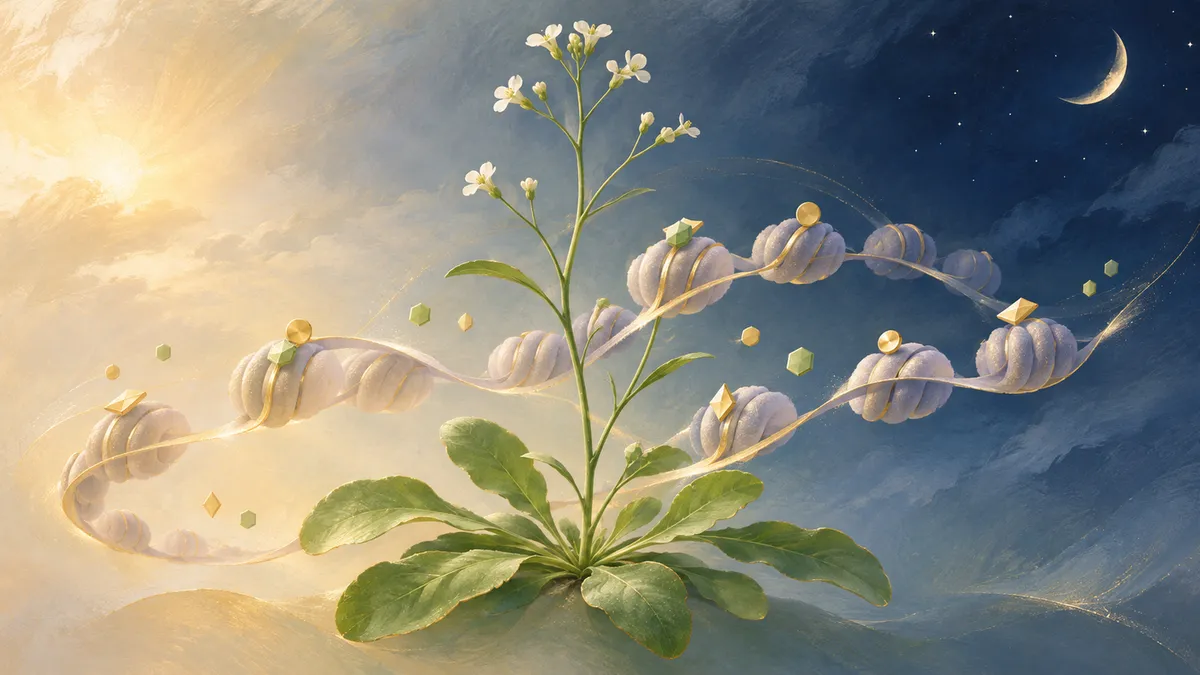
Plants coordinate flowering through pathways that respond to day length and regulate gene activity. Saqlain Haider and colleagues report evidence connecting these systems through two chromatin-associated proteins, with PWO2 having the stronger effect on flowering under the long-day conditions tested.
Connecting daily timing with gene regulation
In Arabidopsis thaliana, flowering depends partly on how the plant coordinates its internal daily clock with daylight. Another layer of control involves chromatin: DNA and its associated proteins, including histones. Chemical modifications to histones help regulate gene activity.
Saqlain Haider and colleagues investigated how two chromatin-associated proteins, PWO1 and PWO2, connect these processes. Their study, posted on bioRxiv on November 4, 2026, is a preprint and has not been certified by peer review.
The researchers combined flowering measurements, gene-expression experiments, genetic crosses and chromatin analysis. Their findings support a role for PWO proteins in regulating PRR7, a gene associated with the plant’s circadian clock and flowering response.
PWO2 had the stronger flowering effect
The team compared wild-type Arabidopsis with mutants lacking PWO1, PWO2 or both. Under long days—16 hours of light followed by eight hours of darkness—plants lacking PWO2 flowered later and produced more rosette leaves before flowering. Plants lacking both proteins largely resembled those lacking PWO2 alone.
Losing PWO1 had a weaker effect: flowering differed slightly by leaf number, but the number of days to flowering was similar to wild type. The authors therefore identify PWO2 as the stronger contributor to flowering-time control in these conditions.
The distinction between the two measurements mattered under short days, with eight hours of light. Plants lacking both proteins took longer to flower but produced fewer leaves before doing so. They also grew more slowly. Describing these plants simply as early- or late-flowering would obscure the different results obtained from calendar time and leaf number.
Gene-expression changes without a detectable period change
To examine daily gene activity, the researchers sampled 10-day-old seedlings every four hours across a long-day cycle. They found altered expression patterns in several genes involved in the clock and flowering.
PRR7 showed a particularly strong response. In plants lacking both PWO proteins, its expression was nearly lost, along with its daily rhythmic pattern. Expression of another regulator, GIGANTEA, or GI, was also reduced at a key sampling time. FLOWERING LOCUS T, or FT, which promotes flowering, had reduced expression at the end of the light period. By contrast, CONSTANS, or CO, showed largely unchanged gene expression across the cycle.
These findings did not translate into a detectable change in the length of the plant’s free-running circadian cycle. Using leaf movements under constant light and temperature, the researchers found no significant period differences between the PWO mutants and wild type. That result applies to the assay and conditions examined; it does not negate the observed changes in individual genes.
Genetic crosses implicate PRR7
The team next combined the loss of both PWO proteins with a mutation in PRR7. In the reported comparison, plants lacking PWO1 and PWO2 flowered at about 42 days, those lacking PRR7 at 59 days, and plants lacking all three at 60 days.
The similarity between the PRR7 mutant and the triple mutant extended to leaf number and FT expression. The authors interpret this as genetic evidence that PRR7 is epistatic to PWO1 and PWO2: its mutation masks their additional effect on these flowering measurements.
Crosses involving CO and GI produced more complex outcomes. For example, removing both PWO proteins from CO-deficient plants delayed flowering further in days, despite similar leaf numbers. These results indicate that the relationship cannot be described fully by one simple chain of flowering regulators.
A chromatin mark at PRR7
The researchers measured H2Aub, a modification in which a ubiquitin molecule is attached to histone H2A. The paper describes this as a repressive chromatin mark and cites earlier work linking PWO proteins to its removal through the enzyme UBP5.
Plants lacking both PWO proteins had significantly increased H2Aub just downstream of the PRR7 transcription start site at eight and 12 hours after lights-on. No corresponding change was detected at the tested GI region, despite reduced GI expression.
Together, these observations support the authors’ model linking PWO-dependent chromatin regulation with PRR7 expression and flowering. Important steps remain unresolved: CO protein abundance and activity were not confirmed in the double mutant, and additional flowering pathways were not established. Flowering experiments were repeated twice, expression measurements used three biological replicates, and chromatin measurements used two. The evidence concerns Arabidopsis under the tested laboratory conditions.
- Arabidopsis thaliana
- flowering time
- chromatin
- circadian clock
- PWO1
- PWO2
- PRR7
- H2Aub
- photoperiod
- preprint