TRANSMISSION // 2026.10.31.763305v1
A tiny genetic prelude helps Arabidopsis make a key light sensor
Source published
A bioRxiv preprint reports that translating a short sequence before the Arabidopsis PHYB coding region is needed for efficient production of the phytochrome B light receptor. Genetic and reporter experiments implicate both the encoded peptide and its position, but the proposed ribosome-reinitiation mechanism remains unproven.
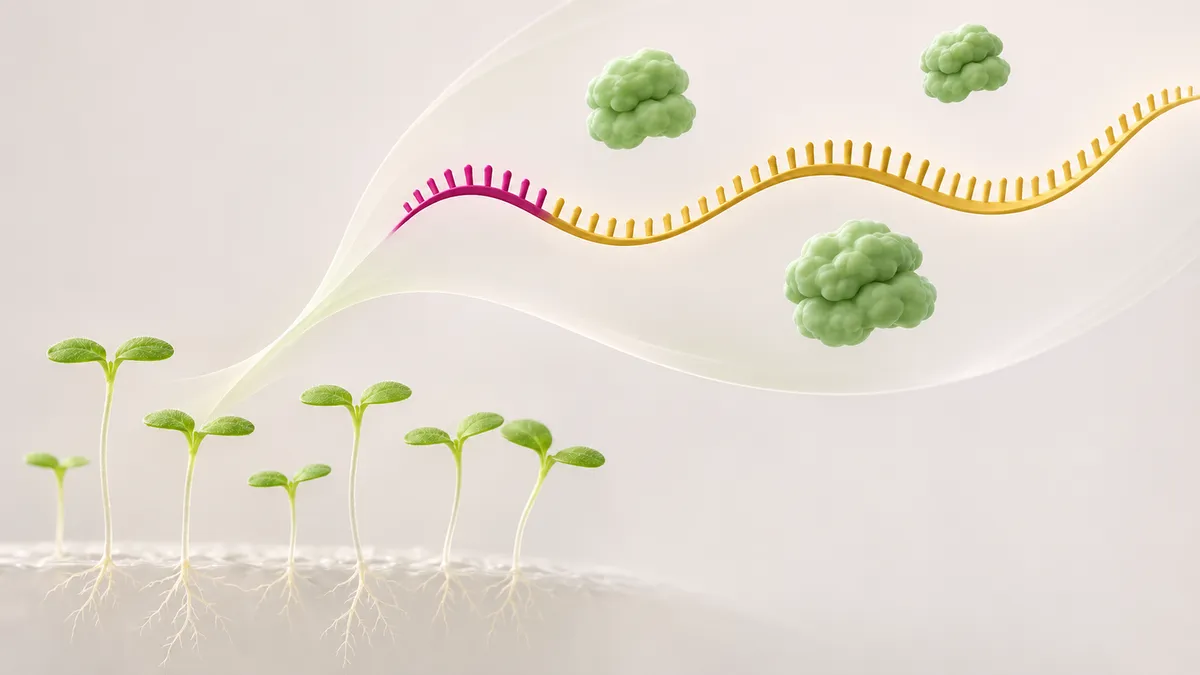
Before Arabidopsis can efficiently produce a major light-sensing protein, its protein-making machinery apparently needs to translate a much smaller sequence on the same RNA. Researchers call this upstream element PHYRE, and their experiments suggest that disrupting it can alter development from seed germination to flowering.
A short sequence preceding a major light-sensor gene appears to have an outsized influence on Arabidopsis development. In a bioRxiv preprint that has not been peer reviewed, researchers report that translating this upstream element is required for efficient production of phytochrome B, or phyB, a receptor involved in coordinating plant growth with light conditions.
The element, named PHYTOCHROME REGULATOR, or PHYRE, sits in the leading region of the PHYB messenger RNA. It is an upstream open reading frame: a short stretch that ribosomes, the machinery that builds proteins, can translate before reaching the main protein-coding sequence. Such elements commonly inhibit downstream protein production. The authors present PHYRE as an unusual example that instead promotes it.
Finding the small sequence
The team began by mapping ribosome activity in seven-day-old Arabidopsis seedlings maintained under white light or exposed to deep shade for 45 or 90 minutes. Their analysis identified 2,856 candidate translated small reading frames, then narrowed these to 208 high-confidence candidates using stricter criteria for read support, coverage and periodicity.
PHYRE stood out because it lay just upstream of PHYB and showed evidence of translation under both white light and shade. The researchers then used CRISPR editing to disrupt its reading frame and examined the consequences.
Under white light, five independent PHYRE-mutant lines developed elongated hypocotyls—the seedling stem below the seed leaves—resembling plants lacking functional phyB. Two mutants examined later in development also showed altered leaf shapes, although their severity differed. The stronger allele flowered early; the weaker allele had a more variable flowering phenotype closer to wild type.
Germination depended strongly on the lighting treatment. After an initial white-light exposure followed by a 15-minute red-light pulse and four days in darkness, germination reached about 75% in wild-type seeds but only 8–10% in the PHYRE mutants. Under white light, however, germination exceeded 95% in both mutant and wild-type seeds. PHYRE disruption therefore did not cause a general inability to germinate.
Separating RNA abundance from protein output
The strongest PHYRE mutant had no detectable phyB protein in the reported western blots, whereas the weaker mutant retained reduced amounts. PHYB messenger RNA fell by about half in the stronger mutant but remained unchanged in the weaker one. That distinction suggested that altered RNA abundance alone could not explain the protein losses.
A genetic rescue experiment provided more direct evidence. In a mutant lacking functional PHYB, a genomic construct containing translatable PHYRE restored phyB protein and normal hypocotyl growth. A counterpart with mutated PHYRE start codons did not, even though both constructs restored PHYB RNA abundance to wild-type levels.
These results support a requirement for PHYRE translation within the tested genetic constructs. They do not establish that supplying the short peptide separately would rescue the defect.
Peptide identity and spacing matter
Reporter experiments helped identify which features contribute to PHYRE activity. Replacing the PHYB coding sequence with a GUS reporter preserved dependence on PHYRE, suggesting that the upstream regulatory region can influence another downstream coding sequence.
In separate luciferase assays performed transiently in tobacco leaves, scrambling the PHYRE peptide sequence partially reduced reporter activity. Changing its RNA sequence while preserving the peptide sequence did not. This supports a contribution from peptide identity, without revealing precisely how the peptide acts.
Distance mattered too. Scrambling the native spacer, described as 35 bases in the reporter experiments, left activity broadly unchanged. Shortening it to 15 bases or extending it to 280 reduced activity, but extending it to 140 did not. The results therefore indicate position sensitivity, not a simple rule that every departure from the native distance is harmful.
The authors propose that translating PHYRE helps ribosomes restart translation at PHYB. That reinitiation mechanism remains a model rather than a directly demonstrated molecular event.
A broader pattern, with limits
A survey of short regions upstream of PHYB in 49 land plant species found PHYRE-like elements across eudicots, but not in the sampled monocot and gymnosperm representatives. Peptide-sequence conservation was much more restricted. Because this was a sequence survey rather than a cross-species functional test, it does not establish that those elements activate PHYB translation.
The study combines Arabidopsis genetics with reporter assays, including experiments in tobacco rather than the native plant context. It also leaves open whether PHYRE has a separate role in shade growth. Its clearest contribution is evidence that translating a small upstream sequence can enable, rather than obstruct, production of an important developmental regulator.
- Arabidopsis thaliana
- PHYRE
- phytochrome B
- upstream open reading frame
- translational control
- photomorphogenesis
- ribosome profiling
- bioRxiv preprint