TRANSMISSION // 2026.10.31.763292v1
Faster membrane remodeling does not mean faster greening in seedlings
Source published
An Arabidopsis study suggests that the membrane lipid phosphatidylglycerol helps stabilize chloroplast precursors and coordinate their development after illumination. Reducing its synthesis accelerated early membrane remodeling and pigment conversion but slowed subsequent chlorophyll accumulation. Removing a second lipid, SQDG, made developmental defects substantially worse.
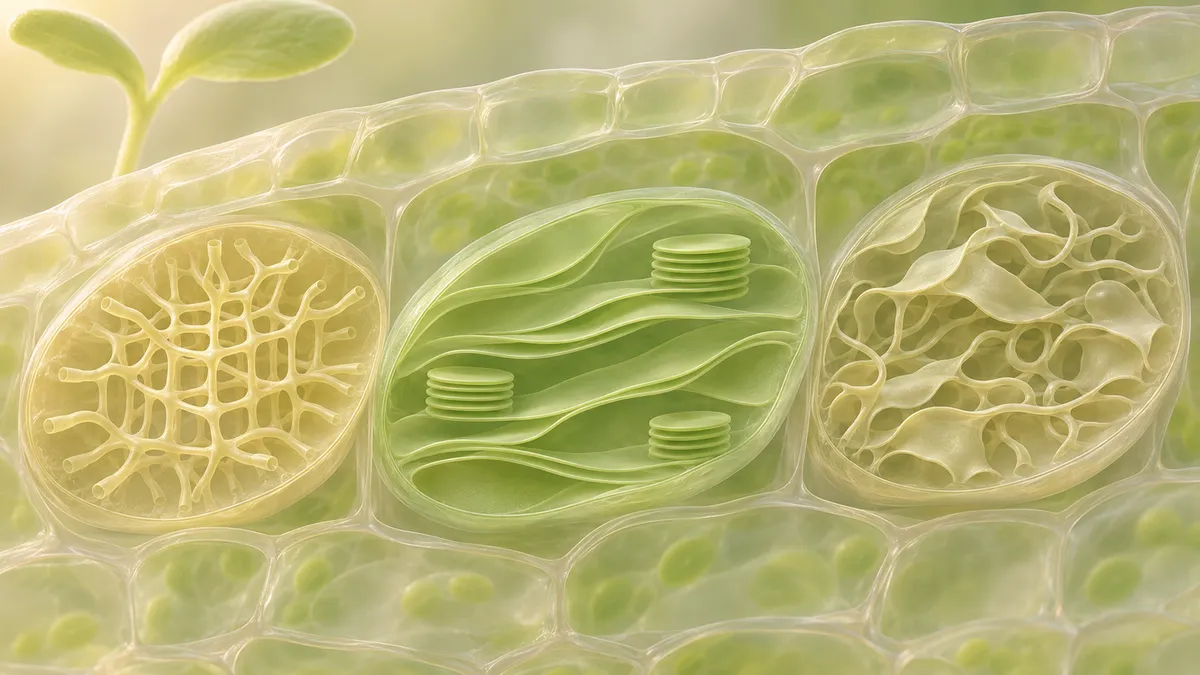
A seedling’s first encounter with light sets off a coordinated rebuilding of its internal membranes and pigments. A bioRxiv preprint finds that speeding up one part of this transition does not necessarily improve the outcome: seedlings with reduced synthesis of a negatively charged membrane lipid dismantled precursor structures faster, yet accumulated chlorophyll more slowly.
Dark-grown seedlings prepare for photosynthesis before they become green. Their seed leaves contain etioplasts, precursors of chloroplasts, with intricate membrane lattices called prolamellar bodies. Illumination initiates the conversion of these structures into the thylakoid membranes that house photosynthetic machinery.
A bioRxiv preprint by Akiko Yoshihara and colleagues, posted November 4, 2026, examines how two negatively charged membrane lipids contribute to this transition. The work, which has not been peer reviewed, suggests that phosphatidylglycerol, or PG, helps stabilize the starting architecture and coordinate later development. The second lipid, sulfoquinovosyldiacylglycerol, or SQDG, appears particularly important when PG synthesis is reduced.
A preparation step changes the picture
The researchers compared wild-type Arabidopsis thaliana with three mutants: pgp1-1, which has reduced PG biosynthesis; sqd1, which lacks SQDG; and a double mutant carrying both changes. Seedlings grew in darkness for four days before experiments tracking membrane structure, pigments, fluorescence and gene expression during illumination.
An important finding came from changing how samples were prepared for electron microscopy. Earlier work had found loosened prolamellar lattices in pgp1-1 seedlings fixed under white light. But fixation involved approximately five minutes of light exposure, potentially allowing remodeling to begin before the structures were preserved.
Under infrared illumination, most pgp1-1 etioplasts instead showed regular lattices resembling those of wild-type seedlings. This supports the interpretation that reduced PG synthesis makes the lattices unusually susceptible to light-induced disassembly, rather than generally preventing their formation in darkness. A minority—5.4% of the examined pgp1-1 profiles—still contained disordered membrane networks.
The comparison has a methodological qualification: infrared preparation also required fixing whole seedlings for longer, rather than dissecting cotyledons first. The preparations therefore differed in more than illumination alone.
Early conversion speeds up, later greening slows
Following illumination, almost all prolamellar lattices in pgp1-1 had transformed into lamellar membranes by three hours. Wild-type and sqd1 plastids could still retain lattice remnants after six hours. By nine hours, however, developing thylakoids showed no marked morphological differences among these three genotypes.
Pigment measurements revealed a similarly accelerated early transition. Dark-grown seedlings accumulate protochlorophyllide, which light converts into chlorophyllide before a further chemical step produces chlorophyll. One minute after a brief flash, the chlorophyll a-to-chlorophyllide a ratio in both PG-deficient genotypes was more than twice that in wild type and sqd1. This ratio supports faster conversion of chlorophyllide, not greater total pigment production.
Fluorescence changes also suggested faster rearrangement or dissociation of pigment complexes containing the enzyme LPOR. The authors propose that destabilizing these complexes could facilitate both membrane disassembly and chlorophyll formation. The sequence remains unresolved: faster pigment release might promote conversion, but activation of chlorophyll synthase could also promote pigment release.
Crucially, this early acceleration did not translate into faster sustained greening. Subsequent chlorophyll accumulation was slower in pgp1-1 and more severely reduced in the double mutant. Quickly processing pigment accumulated in darkness is therefore distinct from efficiently building up chlorophyll after illumination.
SQDG matters when PG is limited
The sqd1 mutant showed no notable developmental defects under the tested conditions. Combining SQDG loss with reduced PG synthesis, however, produced much greater disruption.
After 24 hours of illumination, abnormal membrane structures without thylakoids remained in 26.8% of examined double-mutant plastid profiles, compared with 2.0% in pgp1-1. These percentages describe profiles in thin sections, not independently reconstructed whole plastids. Serial-section analysis of dark-grown double-mutant etioplasts also detected more lattice-containing structures than individual sections did, illustrating how sampling affects structural estimates.
The double mutant additionally showed poorer photosystem II performance and generally weaker light-induced expression of the six photosynthesis-associated genes examined. Together, these findings support a compensatory contribution from SQDG when PG availability is limited, without establishing the precise molecular mechanism.
Higher efficiency is not a complete success measure
The pgp1-1 mutant had higher effective photosystem II quantum yield than wild type after six and nine hours, but not after 24 hours. It also showed less regulated dissipation of absorbed light energy. The authors therefore caution that the higher yield could reflect faster establishment of electron transport, impaired development of energy-dissipation mechanisms, or contributions from both.
The experiments concern controlled Arabidopsis seedling development, and several proposed molecular links remain untested. Their central distinction is nevertheless clear: dismantling a precursor membrane quickly is not equivalent to successfully coordinating pigment synthesis, membrane construction and photosynthetic function.
- Arabidopsis thaliana
- chloroplast development
- etioplast
- prolamellar body
- phosphatidylglycerol
- SQDG
- thylakoid membranes
- chlorophyll biosynthesis
- photosystem II