TRANSMISSION // 2026.10.30.763178v1
Maize’s recovery after chilling reveals differences hidden by the cold
Source published
Experiments with 11 maize inbred lines found that prolonged chilling compressed differences in photosynthesis, while warming revealed variation in recovery. Field results suggest useful genetic variation in several physiological traits, but do not establish gains in grain yield or nitrogen efficiency.
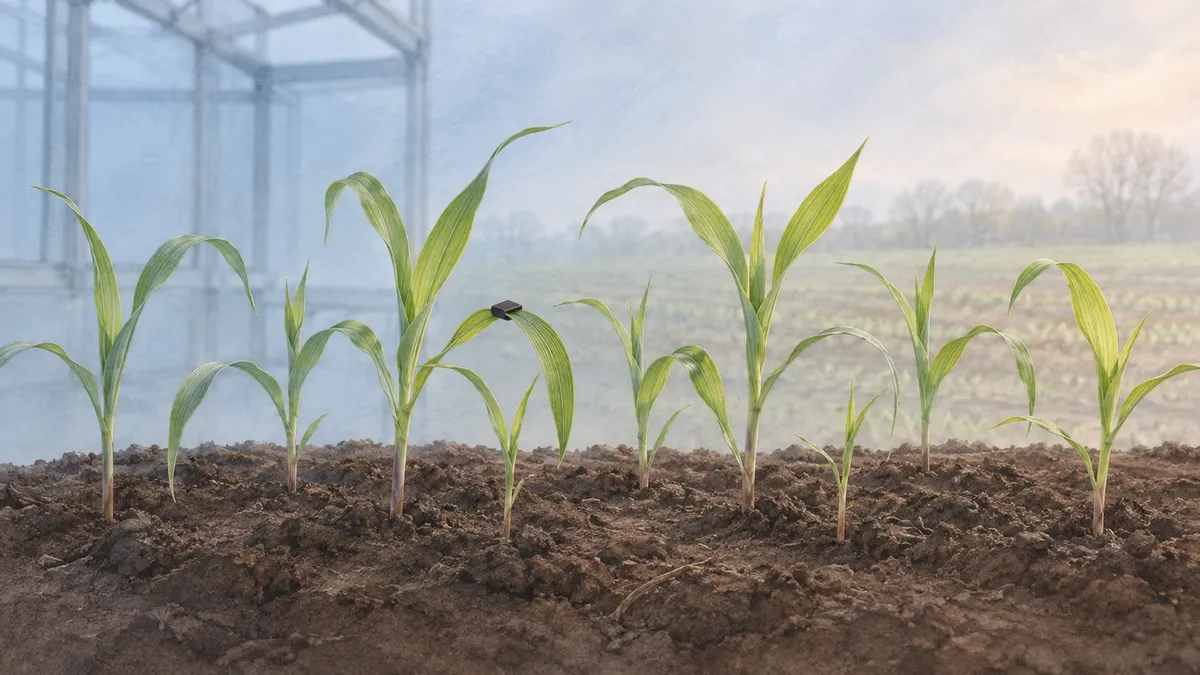
Keeping photosynthesis running during a cold spell and restarting it afterward are different challenges. A not-peer-reviewed bioRxiv preprint suggests that evaluating both could help researchers understand maize’s resilience to early-spring conditions.
Earlier maize planting could extend the growing season and bring crop nitrogen demand closer to the spring availability of soil nitrogen. But those potential benefits depend on seedlings functioning in cold conditions. Tyler J McCubbin, Emma N Leary, Donald Coon and Jacob D Washburn investigated how maize photosynthesis and development respond during chilling and after temperatures rise. Their study, posted on bioRxiv on November 5, 2026, is a preprint that has not been peer reviewed.
The authors’ central finding is that performance during cold exposure does not tell the whole story. Prolonged chilling pushed genetically different plants toward similarly low photosynthetic activity, while warming revealed substantial differences in recovery.
Following plants through cold and recovery
The researchers tested 11 genetically diverse maize inbred lines in growth chambers. Plants experienced five days at day/night temperatures of 22/16°C, five days at 12/10°C, and five days back at 22/16°C. Light intensity rose daily to a relatively high peak intended to approximate bright spring conditions. The chamber experiment was repeated four times and imposed chilling without frost damage.
Measurements combined gas exchange, which tracks net carbon dioxide uptake, with chlorophyll fluorescence, which provides information about the photosynthetic machinery. One fluorescence measure, ΦPSII, describes the proportion of absorbed light used in photosystem II photochemistry under illuminated conditions. The team also measured leaf elongation, developmental stage, chlorophyll status and final biomass.
To examine responses outside the chambers, the same maize panel was tested in four early-spring field environments: two Missouri locations across 2025 and 2026. Seedlings were transplanted at the three-leaf stage and monitored over five days, with three replicate blocks per environment. These were short seedling exposures, not season-long trials of directly sown early plantings.
Cold concealed differences that warming revealed
The authors report that average net carbon dioxide assimilation fell by approximately 78% between the prechill endpoint and the end of chilling. ΦPSII declined rapidly at the onset of cold exposure. Stomatal conductance, a measure of gas movement through leaf pores, did not show a matching immediate decline. That timing argues against stomatal closure alone explaining the initial loss of carbon uptake, but does not identify a single responsible mechanism.
By the end of chilling, pairwise differences in assimilation among maize lines were no longer statistically detectable. Differences reappeared during recovery. LH244 had the highest assimilation before chilling, whereas B97 showed the strongest photosynthetic recovery. This distinction supports evaluating recovery separately from the ability to maintain function during stress.
Growth also slowed. Developing leaves elongated less during chilling, and progression to successive mature-leaf stages largely stalled. Both resumed after warming. Plants further advanced in development at the recovery endpoint had a larger fraction of their leaf biomass in mature tissue. This association connects development with biomass allocation; it does not establish that one photosynthetic measurement caused the allocation pattern.
Useful signals, but no universal winner
Carbon assimilation and ΦPSII were most closely associated during chamber recovery. They were also positively associated across the pooled field observations, although the relationship varied strongly among environments. Genotype rankings shifted between sites and years, and no maize line was consistently superior across traits.
The authors estimated moderate broad-sense heritability for field assimilation and moderate-to-high heritability for ΦPSII in their primary analysis. Such estimates describe genetic contributions to variation within this panel and experimental design; they do not guarantee breeding gains elsewhere. Chlorophyll readings were more highly heritable, but the authors caution that retaining chlorophyll is not equivalent to maintaining carbon uptake.
Two Miscanthus accessions provided another caution about generalization. Neither maintained higher assimilation than the maize panel during chilling. The finding applies to the material tested, rather than overturning previous evidence of exceptional chilling tolerance in other Miscanthus accessions.
What the experiments cannot establish
Light intensity was not varied independently alongside temperature, so the study cannot separate the effects of chilling, high light and their interaction. The authors also note that sustained chamber chilling represents only one possible spring stress pattern. Gradual cooling, repeated cold nights and changing root-zone temperatures could produce different responses.
The small inbred panel, short field exposures and environment-dependent rankings constrain broader agronomic conclusions. The data-availability statement says primary supporting data were not publicly available at posting and could be requested from the corresponding author.
Most importantly, these experiments did not establish grain-yield gains or improved nitrogen efficiency. Those remain agronomic goals. The evidence instead identifies measurable variation in photosynthetic maintenance, recovery and renewed development—components researchers can investigate without treating seedling resilience as proof of a better-performing crop.
- maize
- chilling stress
- photosynthetic recovery
- chlorophyll fluorescence
- photosystem II
- genetic variation
- early-season planting
- preprint
Related reading
Automatically matched by shared topic keywords. These links do not imply that the sources agree or establish a consensus.