TRANSMISSION // 2026.10.26.762021v1
A New Zealand orchid turns fungus-gnat courtship into a pollination opportunity
Source published
Researchers observed male and female fungus gnats mating on a nectarless spider orchid and carrying its pollen. Some females also laid eggs on the flowers, where their larvae did not survive. The signals drawing the insects remain uncertain.
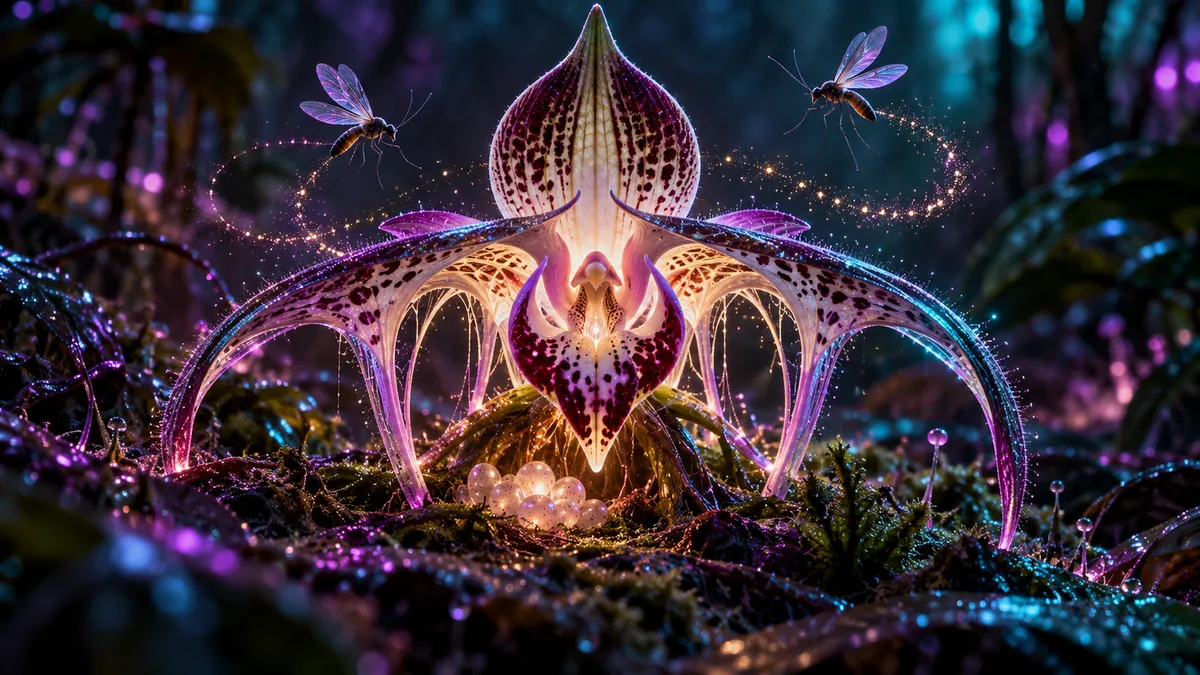
A flower on the forest floor can serve as a meeting place for fungus gnats—and, for some of their offspring, a dead end. A New Zealand study suggests that an orchid benefits from both sides of the encounter.
A meeting place with a hidden cost
On a New Zealand forest floor, a male fungus gnat lands on a spider orchid and begins to fan his wings. His abdomen moves up and down; his claspers open. If a female approaches, the pair may mate on the flower. Later, she may probe its surface with her egg-laying organ. In controlled observations, females also laid eggs on the flowers.
For the orchid, the encounter can deliver pollen. For larvae hatched on the flower, the outcome observed by researchers was fatal: they died after a few days, apparently without suitable food. Larvae transferred to pieces of mushroom reached adulthood.
These observations come from a bioRxiv preprint led by Carlos Lehnebach of the Museum of New Zealand Te Papa Tongarewa. The team studied an orchid known informally as Corybas Remutaka, a taxonomically undescribed entity found in southern beech forests in parts of the North and South Islands. The preprint has not been certified by peer review.
The authors propose that the nectarless orchid combines two forms of pollination deception. Its flowers provide a rendezvous where gnats court and mate, while also serving as an unsuitable site for egg laying. The insects carry pollen as they explore the flower, but exactly what draws them in remains unresolved.
Testing the orchid's dependence on visitors
Across three flowering seasons, the researchers excluded insects from some flowers and applied pollen by hand. Other flowers were left covered without pollination, or left open to natural visitors. They also watched and filmed insects in the field and reared gnats from eggs found on flowers for observations under controlled conditions.
The hand-pollination experiments showed that the orchid can use its own pollen but does not readily pollinate itself without assistance. Fruit developed on 24 of 32 hand-self-pollinated flowers and 20 of 22 hand-cross-pollinated flowers. None of the 21 covered, intact flowers left to self-pollinate automatically formed fruit.
Natural fruit production was much lower: the table reports 12 fruits among 79 exposed flowers, or about 15%. The paper's results text instead describes this as 12%, but the count in the table gives the higher figure. The contrast with hand pollination is consistent with limited pollination in the field, although it does not establish why pollination was limited.
The only flower visitor the team observed over the three seasons was the endemic fungus gnat Mycetophila phyllura. Both males and females were seen carrying the orchid's pollen packages, called pollinia, and the researchers report that both could remove and deposit them. A nearby trap collected 20 other Mycetophila species during flowering, suggesting that the observed interaction was selective. Still, observations at the study sites cannot rule out other visitors elsewhere.
Chemical clues, not a solved lure
To investigate possible signals, the team analysed chemicals from orchid plants and flower parts and compared them with extracts from an unidentified mushroom on which the gnats had been seen mating or laying eggs. They also examined flower surfaces microscopically, used a stain to look for possible scent-producing regions and photographed flowers through a UV-pass filter.
The orchid and mushroom extracts shared several tentatively identified compounds. The researchers did not detect several chemicals often associated with fungal odours, including 1-octen-3-ol, in either the orchid samples or the mushroom tested. That does not rule out chemical mimicry: the analysis included only four orchid samples for airborne compounds and one unidentified mushroom specimen, and scent may change with time or developmental stage.
Nor does a shared compound prove that a gnat can smell it or that it causes attraction. Some compounds were found through solvent extraction, which can recover non-volatile substances as well as scent chemicals. The authors call for confirmation of chemical identities and behavioural and electrophysiological tests to determine which compounds, if any, matter to the gnats.
UV-reflecting regions and microscopic structures on the flower might also influence insect movement, the team suggests. One captive female was seen becoming trapped inside a flower and dying, but the proposed roles of the flower's surfaces and openings in directing or trapping gnats were not experimentally established.
The study therefore offers a detailed account of an unusual encounter, rather than a complete explanation of its mechanics. What is clear from the observations is that the same flower can host courtship, receive pollen and hold eggs whose larvae fare poorly there. How the orchid draws its visitors—and how consistently this relationship operates across its range—remains to be tested.
- Corybas Remutaka
- fungus gnats
- orchid pollination
- pollination deception
- New Zealand
- floral scent