TOPIC DOSSIER // Quantum Physics
Quantum computing: what counts as an improvement?
Six selected preprints connect atomic control, molecular calculations and the conditions behind claims of quantum advantage.
INDEPENDENT SIGNAL // RESEARCH & CONTEXT
Research through a different lens. Source-grounded reporting on science and the systems shaping our world.
HOW THIS WORKS ↗PUBLICATION INDEX
RESEARCH SYNTHESIS
Briefs, dossiers and reviewed contested questions grounded in original research.
TOPIC DOSSIER // Quantum Physics
Six selected preprints connect atomic control, molecular calculations and the conditions behind claims of quantum advantage.
TOPIC DOSSIER // Quantum Physics
Five selected preprints connect engineered photon pairs, molecular measurements, persistent patterns and the mathematical limits of perfect quantum performance.
WEEKLY BRIEF // Quantum Physics
Six selected preprints connect quantum-state preparation, measurement choices and the limits of evidence for useful outcomes.
CHANNEL // 01 [759]
Research into artificial intelligence and intelligent systems.
Source published
The RADE framework proposes judging deployed AI by the useful work it delivers after accounting for computation, retries, human review and consequential mistakes. Its central distinction: some costs can be traded against benefits, but severe harms require explicit limits. This is a conceptual preprint, not an experimental demonstration.
Source published
A preprint examining U.S. campaign websites, X posts and emails found increasing amounts of detectable AI-generated content between 2023 and 2025. Disclosures were rare in the material reviewed, but imperfect detectors and incomplete coverage limit conclusions about actual AI use or legal compliance.
Source published
A hybrid trading system’s paper account beat market benchmarks but suffered deeper losses along the way. Crucially, that account used deterministic fallbacks, not language-model assessments. Retrospective simulations examine the AI components without establishing that they improve investment performance.
CHANNEL // 02 [76]
Research into plants, their biology, and their environments.

Source published
A preprint reports far more mature embryos from one hybrid fir culture grown with maltose rather than sucrose, alongside earlier accumulation of raffinose. The sugar patterns offer clues to maturation, but do not establish its mechanism or guarantee normal seedling development.

Source published
A Bayesian model fitted to simulated wheat growth separated genetic, environmental and interaction effects. Growth timing and curve shape showed relatively little genotype-by-environment interaction, while the final biomass level showed much more. Real-world prediction and breeding benefits remain untested.

Source published
A non-peer-reviewed preprint ranks 11 Hibiscus mutabilis cultivars using measurements and expert-selected priorities. Three lead the scoring system, but the results do not establish food safety, nutritional benefits or consumer acceptance, and conflicting descriptions need clarification.
CHANNEL // 03 [304]
Research into economic systems, decisions, and policy.

Source published
A new preprint proposes Factor-Augmented Double Machine Learning, a method for analyzing panel data when observed controls and hidden common forces both matter. Simulations show improved confidence-interval coverage under strong hidden confounding; a U.S. application links higher minimum wages to a smaller lower-tail wage gap.

Source published
A North Macedonia preprint combines census totals with service-access maps to estimate local multidimensional poverty. Its central lesson: missing household links leave national poverty levels uncertain, but some rural–urban differences remain clear.
Source published
A new preprint develops tests that separate shortcomings in downside-risk forecasts from errors introduced by fitting models with many predictors. Simulations improve false-alarm control, while a G7 application finds omitted financial information in US downside-growth forecasts.
CHANNEL // 04 [353]
Research into stars, galaxies, cosmology, planets, and the physics of the universe.
Source published
Francisco Cuadra and colleagues find an unusual chemical pattern in the carbon-rich star DR20080. Their models favor enrichment mainly by a faint Population III supernova, with a smaller contribution from a hypernova, although the progenitor properties remain uncertain.
Source published
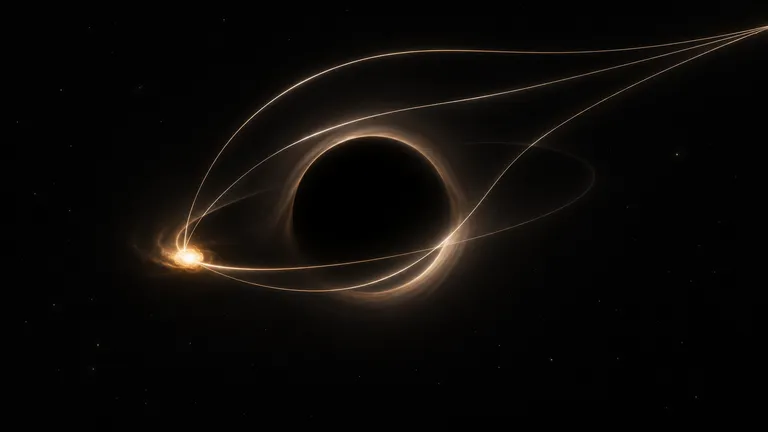
Simulations suggest that light-travel delays, motion and gravitational lensing leave distinct patterns in a fluctuating hot spot’s brightness. Comparing different halves of its image could help reveal an orbit’s orientation, but the method remains untested on realistic accretion flows and observations.
Source published
Astronomers report four unusually lithium-rich giant stars among 209 studied in the Small Magellanic Cloud. Their measurements suggest that stellar mixing and lithium supplied by nova outbursts both help shape the galaxy’s varied lithium abundances, but the origins of the four outliers remain unresolved.
CHANNEL // 05 [150]
Research into quantum mechanics, quantum information, and the quantum behaviour of matter and light.
Source published
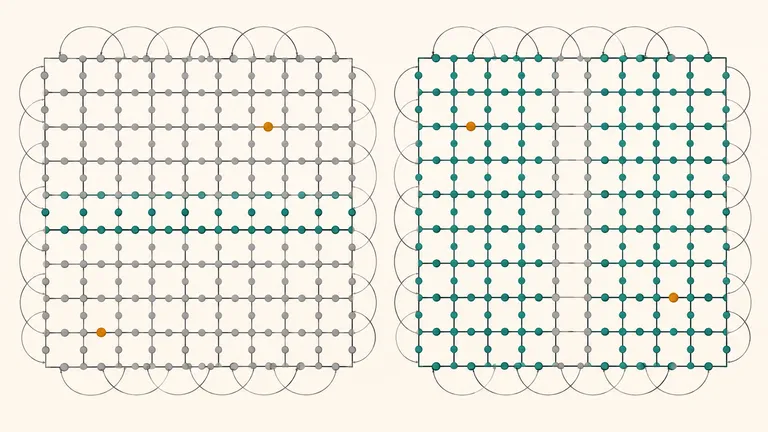
A preprint connects an observer’s ability to infer an encoded logical bit with optimal error correction using only the observed region. Calculations and small superconducting-processor experiments suggest that geometry can prevent leakage, while uniform-noise models can underestimate what an observer learns on uneven hardware.

Source published
A theoretical preprint derives how charge fluctuations in a disordered conductor can correlate the loss of quantum phase across nearby qubits. In a two-dimensional conductor, the predicted correlations weaken with the square of separation and change sign with orientation. A worst-case noise bound grows logarithmically with array size, limiting the applicability of certain fault-tolerance guarantees without proving that error correction fails.
Source published
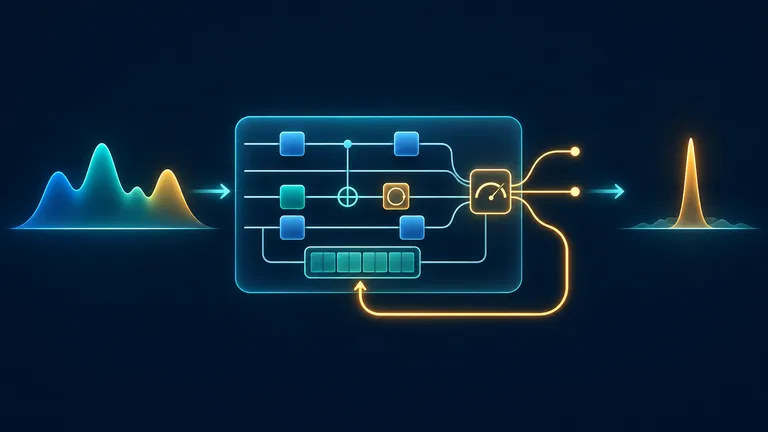
A theoretical preprint presents quantum circuits that use finite memory and repeated measurements to implement rational spectral acceptance probabilities exactly. Two examples show query savings against a specified fixed-depth polynomial baseline, while highlighting limits involving runtime, quantum coherence and hardware costs.